bad AC capacitor symptoms
Signs Your Capacitor Needs Replacement
Everglade Heating and Air is a fully licensed and NATE-certified HVAC company serving San Diego County homeowners, landlords, and businesses since 2020.
- 1.What Are the 10 Most Common Bad AC Capacitor Symptoms?
- 2.My Condenser Is Humming Right Now. What Should I Do?
- 3.Most Dead Capacitors Look Brand New
- 4.How Do You Tell If a Capacitor Is Bad With a Meter?
- 5.A Capacitor Provides Phase Shift, Not a Boost
- 6.Why Capacitors Fail Faster in Alpine Than in Pacific Beach
- 7.A Dead Capacitor Is Often a Symptom, Not the Root Cause
- 8.Is a Bad Capacitor the Cheap Repair or the Expensive One?
- 9.Why You Should Not Discharge a Capacitor Yourself
- 10.What to Ask the Technician Who Tests Your Capacitor
- 11.Frequently Asked Questions
- 12.Get the Reading Before You Get the Quote
Last updated: 2026-09-09
Most dead capacitors look brand new. Every page about bad AC capacitor symptoms leads with swollen tops and oil leaks. So you open the panel, see a clean flat can, and cross the capacitor off your list. That is the wrong call. I have pulled capacitors off condensers in El Cajon and Spring Valley that looked factory fresh and read zero.
A failing AC capacitor makes the outdoor unit hum without starting. It can also stop the condenser fan, cause hard starts, or shut the system down with no sound at all. Proof is a capacitance reading measured against the rating printed on the can. On a dual capacitor stamped 45+10 µF plus or minus 5%, the compressor side has to land between 42.75 and 47.25 µF. Outside that band it is finished.
What Are the 10 Most Common Bad AC Capacitor Symptoms?
- The outdoor unit hums but nothing turns.
- The condenser fan will not spin while the compressor runs.
- The compressor grunts, then trips off.
- The system starts only sometimes, then runs fine the next cool morning.
- The unit shuts itself down in the hottest part of the afternoon.
- The indoor blower hums or runs slow.
- Air from the vents is warm while the compressor stays quiet.
- The breaker trips after the system tries to start.
- The top of the capacitor is domed instead of flat.
- Oil, residue, or a split seam shows on the can.
Only the last two can be confirmed by looking. The other eight also fit a pitted contactor, a bad fan motor, or a blown fuse. That is why a full electrical diagnosis comes first.
My Condenser Is Humming Right Now. What Should I Do?
Turn the system off. Not later, now.
Set the thermostat to OFF. Then kill the outdoor breaker or pull the disconnect beside the condenser. A humming compressor that will not turn is sitting at locked rotor amps, the current a motor draws when it is powered and stuck. That is 5 to 8 times the normal load, and it becomes heat in the windings in seconds. Ten minutes does real damage. An hour can cost you the compressor. Stop resetting the breaker to see if it catches. If the capacitor is split or leaking, book emergency AC repair.
Most Dead Capacitors Look Brand New
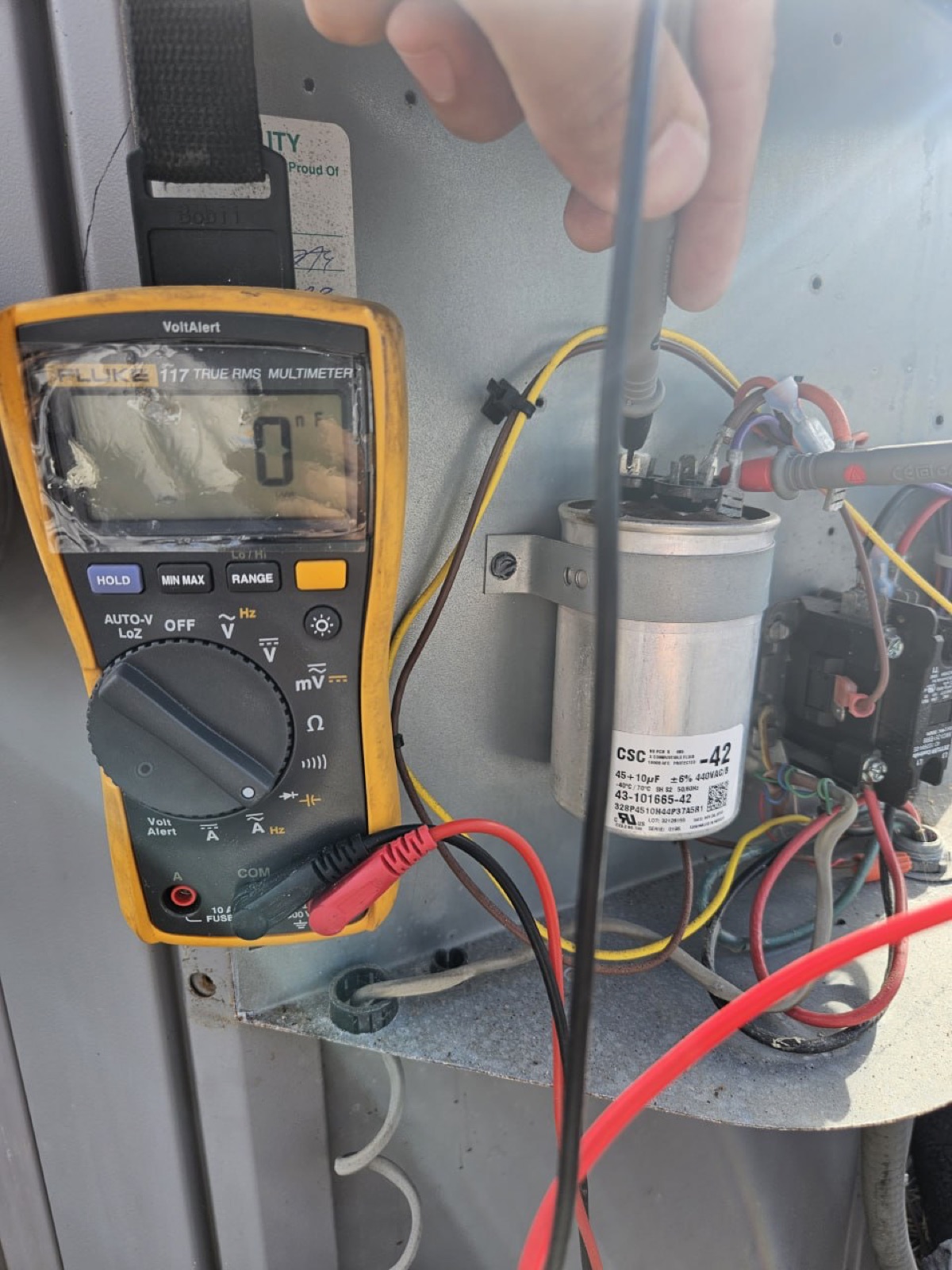
That photo is from one of my own calls. The capacitor is labelled 45+10 µF plus or minus 5%, 440VAC. The case is flat and the seams are clean. My Fluke 117 True RMS meter reads 0 across the compressor terminals. A 45+10 reading 0 is not weak. It is gone. That homeowner had looked at the same part, seen nothing wrong, and spent two days blaming the compressor.
How Do You Tell If a Capacitor Is Bad With a Meter?
You compare measured microfarads against the rating and tolerance stamped on the can. Tolerance is usually plus or minus 5%, sometimes plus or minus 6% on aftermarket parts. Here is the math on the photo unit.
- Rated 45 µF on the compressor side. 5% of 45 is 2.25, so the pass band is 42.75 to 47.25 µF.
- Rated 10 µF on the fan side. 5% of 10 is 0.5, so the pass band is 9.5 to 10.5 µF.
- A reading of 43.5 µF passes. The fault is somewhere else.
- A reading of 31 µF is a 31% loss. That part is failing.
- A reading of 0 is dead, which is what the photo shows.
The capacitor has to be isolated from the circuit before it is measured. With the motor leads still on, the meter reads through the windings and hands you a passing number on a dead part.
A Capacitor Provides Phase Shift, Not a Boost
A capacitor gives a motor phase shift, not a boost. It pushes the start winding's current out of step with the main winding, and those two currents make a spinning field that turns the rotor.
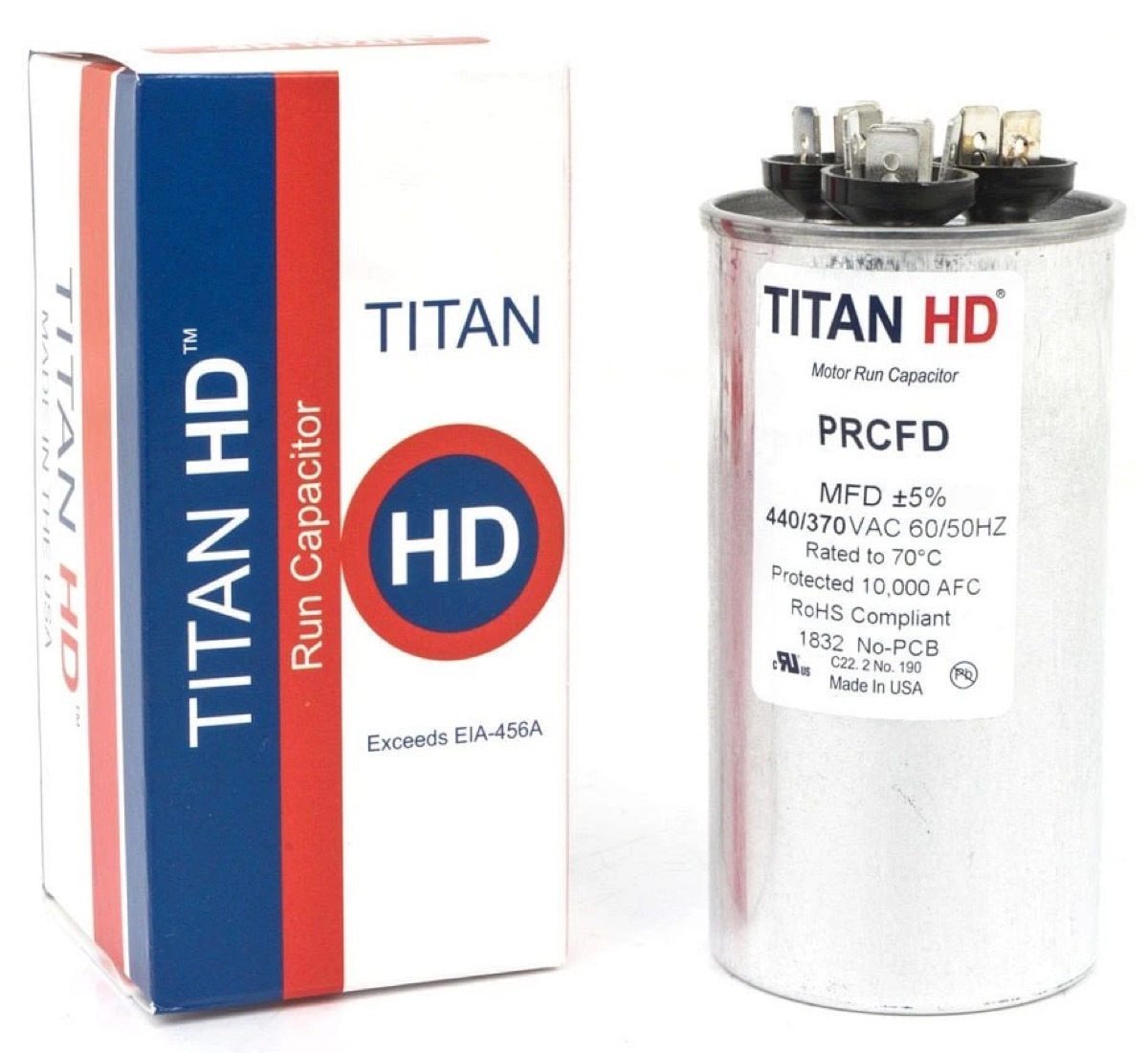
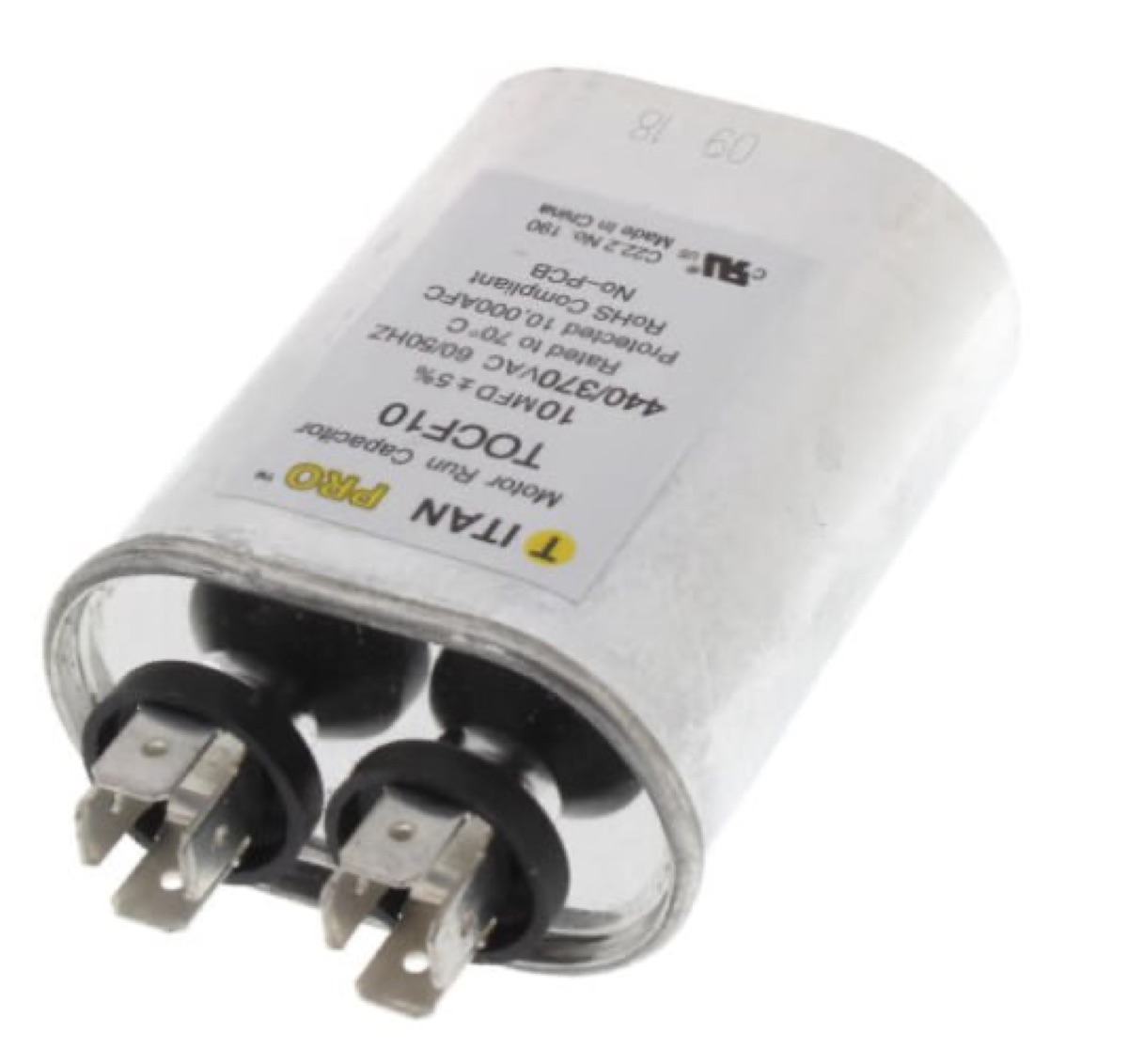
Round dual run capacitors have three terminal groups and feed both the compressor and the condenser fan. Oval single run capacitors have two terminals and feed one motor.
What C, HERM, and FAN Mean
- C is common. Both sections share it.
- HERM is the sealed compressor, the 45 µF section in the photo.
- FAN is the outdoor fan motor, the 10 µF section.
The bigger value always feeds the compressor. Swap those two leads and the compressor gets 10 µF while the fan gets 45 µF. Neither starts. Both cook. A 440VAC capacitor can replace a 370VAC one, because a higher rating is a wider safety margin. The reverse is never okay, and microfarad values have to match the nameplate.
Why Capacitors Fail Faster in Alpine Than in Pacific Beach
National articles quote one 5 to 10 year lifespan and never ask where the unit lives. In San Diego County that number splits in half. A summer afternoon in Alpine, Santee, El Cajon, or Spring Valley runs 20 to 30 degrees above the same afternoon in Pacific Beach or La Jolla, and those systems run longer hours.
Inland units here give up run capacitors at about 3 to 6 years. Coastal units in the same line reach 8 to 12 years. Same part, different zip code. Checking capacitance during annual preventative maintenance catches a weak one before August, and the ENERGY STAR maintenance checklist covers the homeowner half.
A Dead Capacitor Is Often a Symptom, Not the Root Cause
Parts retailers leave this out, because their story ends when you buy the capacitor. A fan motor with dry bearings drags, pulls higher amps, and cooks the capacitor every cycle. A compressor fighting high head pressure does the same. The capacitor is the cheapest part in the circuit, so it dies first. It is the fuse, not the arsonist.
A capacitor that fails twice inside two summers is not a capacitor problem. Clamp the fan motor's amp draw against nameplate FLA, the full load amps it is rated for, and the compressor against its RLA. A motor pulling above nameplate needs blower motor replacement, not a third capacitor. Skip that check and you buy the same part every July.
Is a Bad Capacitor the Cheap Repair or the Expensive One?
A capacitor is the least expensive part in that cabinet, and capacitor replacement is a one visit repair we finish the same day. A compressor sits at the other end, close enough to a new outdoor unit that the honest talk turns to replacement. From outside, the two look the same. A humming unit that will not start is a capacitor about 7 times out of 10 on my calls. A meter settles it in five minutes. Guessing does not.
Why You Should Not Discharge a Capacitor Yourself
Killing a breaker makes house wiring safe. A capacitor is built to do the opposite. It sits across about 240 volts and keeps that charge after the breaker is off and the disconnect is pulled, even hours later. Touch both terminals, or a terminal and the cabinet, and your body is the path.
Do not use the grounded screwdriver trick. It is repeated everywhere, including This Old House, which tells readers a pro discharges the capacitor "using a grounded screwdriver." That dumps the whole charge through a near zero resistance path in one instant. It arcs, it can weld the tool to the terminal, and it ruins the capacitor you were about to test. A pro uses a properly rated bleed resistor instead, then checks for zero volts with a meter.
If checking for zero volts with a meter is not already part of your work, close the panel and call.
What to Ask the Technician Who Tests Your Capacitor
- Ask to see the reading, leads isolated, meter turned toward you.
- Ask for both numbers on the invoice. "Bad capacitor" is not a diagnosis. "Rated 45 µF, measured 0" is.
- Ask for the old part back.
- Ask what the motor pulled if this is your second capacitor in two years.
- Check the license. Ours is CSLB #1154431, confirmable through the CSLB license lookup.
Frequently Asked Questions
Can a capacitor look perfectly fine and still be bad?
Yes, and it is the most common case. Capacitors fail inside with no bulge and no leak. The unit photographed here has a flat, clean case and measures 0 µF against a 45+10 rating. Only a meter proves a part is in tolerance.
How long does an AC capacitor last in San Diego?
Coastal homes in Pacific Beach or La Jolla get 8 to 12 years from a run capacitor. Inland homes in Alpine, Santee, El Cajon, and Spring Valley get 3 to 6 years. Heat breaks down the dielectric, and inland systems run more hours.
Is it safe to test or replace an AC capacitor myself?
No. A capacitor holds a dangerous charge after the breaker is off and the disconnect is pulled. The grounded screwdriver method arcs, can weld the tool, and ruins the part. A pro uses a rated bleed resistor, then checks for zero volts with a meter.
Why did my capacitor fail again after only one summer?
A repeat failure means something else is loading it. A fan motor with dry bearings or a compressor running high head pressure cooks the capacitor every cycle. The fix is measuring motor amp draw against nameplate FLA and compressor draw against RLA.
Get the Reading Before You Get the Quote
If your outdoor unit is humming right now, shut it off at the thermostat and pull the disconnect. Then have the capacitor measured before anyone quotes a part. That number is the difference between the cheapest repair in the cabinet and a compressor conversation.
Everglade Heating and Air is owner-operated and NATE-certified, serving all of San Diego County. For a free diagnostic, call or text Karam at (619) 792-8289, or reach us here.
Ask to see the meter. Every time.
Questions? The Owner Picks Up.
Flat diagnostic fee. Written estimate before any work starts. Serving all of San Diego County.
NATE Certified | EPA 608 (#1112519700410) | CA License #1154431 | Mon–Sat 7AM–7PM