HVAC air filter
HVAC Air Filter: The Right MERV Beats the Highest
Everglade Heating and Air is a fully licensed and NATE-certified HVAC company serving San Diego County homeowners, landlords, and businesses since 2020.
- 1.Key Takeaways
- 2.Where Is My HVAC Air Filter and Which Way Does the Arrow Go?
- 3.Is a Higher MERV Filter Always Better?
- 4.What MERV Rating Should You Use in a San Diego Home?
- 5.The EPA Says MERV 13. Most San Diego Filter Slots Are 1 Inch Deep.
- 6.How Can You Test HVAC Airflow Without Tools?
- 7.What Filter Should You Use During Wildfire Smoke Season?
- 8.Should You Use a Washable HVAC Filter?
- 9.How Often Should You Change an HVAC Air Filter?
- 10.What Most San Diego Homes Do Not Need
- 11.Condos, Rentals, and Systems More Than 12 Years Old
- 12.Frequently Asked Questions
- 13.The Right Filter Is the One Your System Can Breathe Through
Last updated: 2026-09-08
The right HVAC air filter is the highest MERV rating your system can pull air through, not the highest number on the store shelf.
For most San Diego County homes with a 1-inch filter slot, that means MERV 8 for everyday use and MERV 11 if you have pets or allergies. The EPA recommends at least MERV 13 for cleaner indoor air, and MERV 13 is reachable, but usually in a 4-inch media cabinet rather than a 1-inch slot. The real limit is not the MERV number, it is face velocity, meaning how fast air gets forced through the filter surface. Buy for the slot you actually have, then change it on schedule.
Key Takeaways
- Restriction is driven by face velocity, not the MERV label: a clean MERV 13 in a deep cabinet often reads lower static pressure than a loaded MERV 8 in a 1-inch slot.
- The EPA recommends MERV 13, or as high as your system will accommodate, during wildfire smoke events.
- Replacing a clogged filter can cut an air conditioner's energy use by 5% to 15%, according to the U.S. Department of Energy.
Where Is My HVAC Air Filter and Which Way Does the Arrow Go?
The arrow printed on the filter frame points toward the furnace or air handler, in the same direction the air travels. Your filter sits on the return side, and in San Diego County homes it lives behind a hallway or ceiling return grille, in a slot beside the furnace, or at the attic air handler.
- Find the return. Run the fan and hold your hand near each grille, because the one pulling air in is the return.
- Shut the system off at the thermostat before opening a door or grille.
- Slide the old filter out and read the frame, where the size is printed along the edge, like 16x25x1.
- Point the arrow on the new filter toward the furnace or air handler, away from the room.
- Slide it in and turn the system back on.
Backwards is the mistake I see most often on a first filter change. The pleated face should meet the dirty air first, because a backwards filter still catches dust but collapses early and loses the surface area you paid for. Filter changes are the cheapest part of preventative maintenance, and skipping them turns a filter problem into a blower motor problem.
Is a Higher MERV Filter Always Better?
No, and the reason is narrower than most articles admit. MERV is defined by ASHRAE Standard 52.2, last revised in 2017, which rates capture efficiency and says nothing about how hard your blower has to work. A higher MERV filter hurts airflow only when it has too little surface area for the air moving through it, a measurement called face velocity: the volume of air divided by the filter face area. Pressure drop climbs with face velocity and with dust load, not with the MERV number on its own.
Most filter guides treat "high MERV" and "dirty filter" as two separate problems, when they are the same problem measured at two moments. A clean MERV 13 in a properly sized 4-inch cabinet routinely reads lower static pressure than a MERV 8 in a 1-inch slot at the end of its life. Depth buys pleat area and pleat area buys airflow, which is why the fix for a restrictive filter is almost never a lower MERV rating. It is a bigger filter.
Residential equipment is typically rated for 0.5 inches of water column of total external static pressure, supply and return together. A tight 1-inch filter on an undersized return can spend a quarter of that budget alone, and restrictive ductwork pushes the system past its rating while the equipment is still new.
What MERV Rating Should You Use in a San Diego Home?
Pick one row. Each names what the rating costs you in airflow.
| MERV | What it captures | Airflow cost | Who it fits |
|---|---|---|---|
| MERV 1-4 (fiberglass) | Lint and hair only | Almost none | Nobody, since it guards the blower, not your lungs |
| MERV 8 | 70% of particles 3 to 10 microns: dust, pollen, lint | Low in a 1-inch slot | Most San Diego homes |
| MERV 11 | Adds 65% of particles 1 to 3 microns (dander, mold spores) plus 85% of the coarse range | Moderate, fine in a clean slot | Pets, heavy dust, allergies |
| MERV 13 | Adds 50% of particles 0.3 to 1 micron (smoke, bacteria) plus 90% of the coarse range | High in a 1-inch slot, low in a 4-inch cabinet | Smoke season, asthma |
| MERV 14 and higher | Finer particles still | Beyond most home blowers | Only after static pressure is measured |
A pleated MERV 8 costs a few dollars more than fiberglass and earns the difference. A 4-inch media filter costs more up front, but one covers 6 to 12 months instead of one to three, so the annual spend lands closer than the sticker suggests.
The EPA Says MERV 13. Most San Diego Filter Slots Are 1 Inch Deep.
The EPA's guidance on MERV ratings is to use at least MERV 13, or the highest rating your system will accommodate. Almost every home I open in Spring Valley, El Cajon, and La Mesa has a 1-inch slot built when MERV 6 was the assumption, so those two facts sit in open conflict and no MERV chart resolves it.
A 1-inch MERV 13 is not automatically wrong, but it only holds up when the return is generous and the filter gets changed close to monthly, because in a home with one undersized return that filter is strangling the blower by week six. I have pulled MERV 13 filters out of 1-inch slots bowed inward and sucked halfway past the frame, with unfiltered air pouring around every edge. That is not filtration, that is a leak with a price tag.
If MERV 13 genuinely matters to you, and in a household with asthma it should, the honest answer is a 4-inch media cabinet on the return, which is an installation rather than a store purchase. Never force a 4-inch filter into a 1-inch slot, because it cannot seal and everything bypasses it.
How Can You Test HVAC Airflow Without Tools?
Pull the filter out, run the fan for 15 minutes, and feel the supply registers, because that comparison is the whole test. If the air gets noticeably stronger with the filter out, the filter was your restriction and a deeper media choice will fix it. If nothing changes, the restriction is downstream: a dirty blower wheel, an iced coil, crushed flex duct, or a return never sized for the equipment.
Never run without a filter beyond those few minutes, because dust landing on the evaporator coil has to be washed off by hand later. A whistling or rattling return grille also means the system is starving for air even when the filter looks clean, which points at the ductwork rather than the filter.
What Filter Should You Use During Wildfire Smoke Season?
During a smoke event, run the highest MERV rating your system will accept and change it far more often than usual. EPA guidance on wildfires and indoor air quality is MERV 13 or as high as the system accommodates, because wildfire smoke is dominated by particles under 1 micron that a MERV 8 largely passes straight through.
For a San Diego home with a 1-inch slot, the practical version is this: install a MERV 13 for the event, run the fan continuously instead of on auto, and expect to pull that filter after 2 to 4 weeks rather than three months. A temporary high-MERV filter changed aggressively is a different decision from a permanent one left in all season, which overloads the blower for months. If your system cannot handle MERV 13, a portable air cleaner in the bedroom does more good than a filter you cannot support.
Should You Use a Washable HVAC Filter?
For a ducted furnace or air handler, no, use a pleated disposable instead. Washable panel filters for ducted systems typically test in the MERV 1 to 4 range, so they stop lint while passing nearly everything you wanted stopped, and they go back in damp.
Ductless Mini-Splits Are the Exception, So Rinse Those Screens
If you own a ductless mini-split, the washable screen inside the head unit is meant to be washed, and that is the design rather than a shortcut. Open the front cover, lift the mesh screens out, rinse them under the tap, dry them completely, and reinstall them monthly during heavy use.
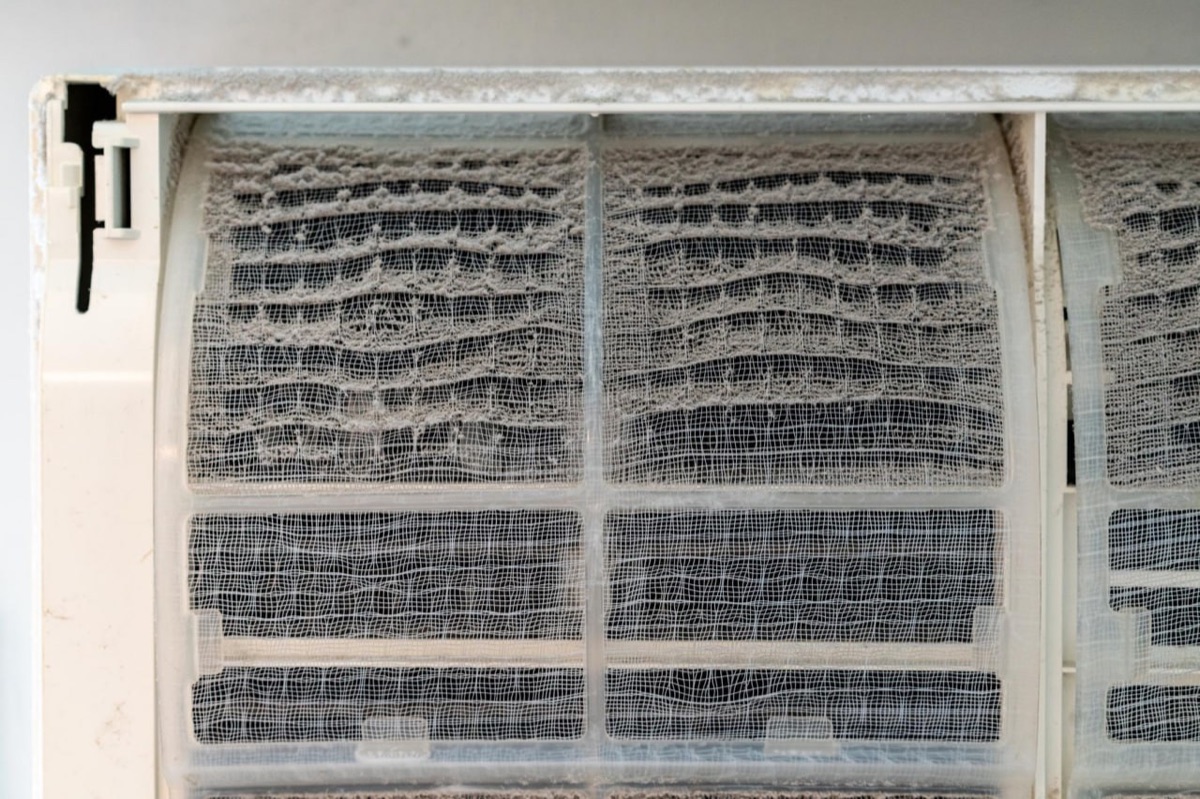
That photograph shows a screen nobody has touched in a year, and I find them in that condition constantly. The homeowner calls because the unit is not as cold as it used to be, and the screen has become a grey felt mat. Rinsing it takes five minutes and usually restores most of the lost capacity, so if you are getting a mini-split installation, set a reminder the day it goes in.
How Often Should You Change an HVAC Air Filter?
Inspect it every 30 days and change a 1-inch filter every 1 to 3 months, while a 4-inch media filter runs 6 to 12 months. Those are starting points, because the filter gives you the real answer through the light test: hold it up to a bare bulb or a window. If light still passes through the pleats it has life left, and if most of the surface blocks light it is spent no matter what the calendar says.
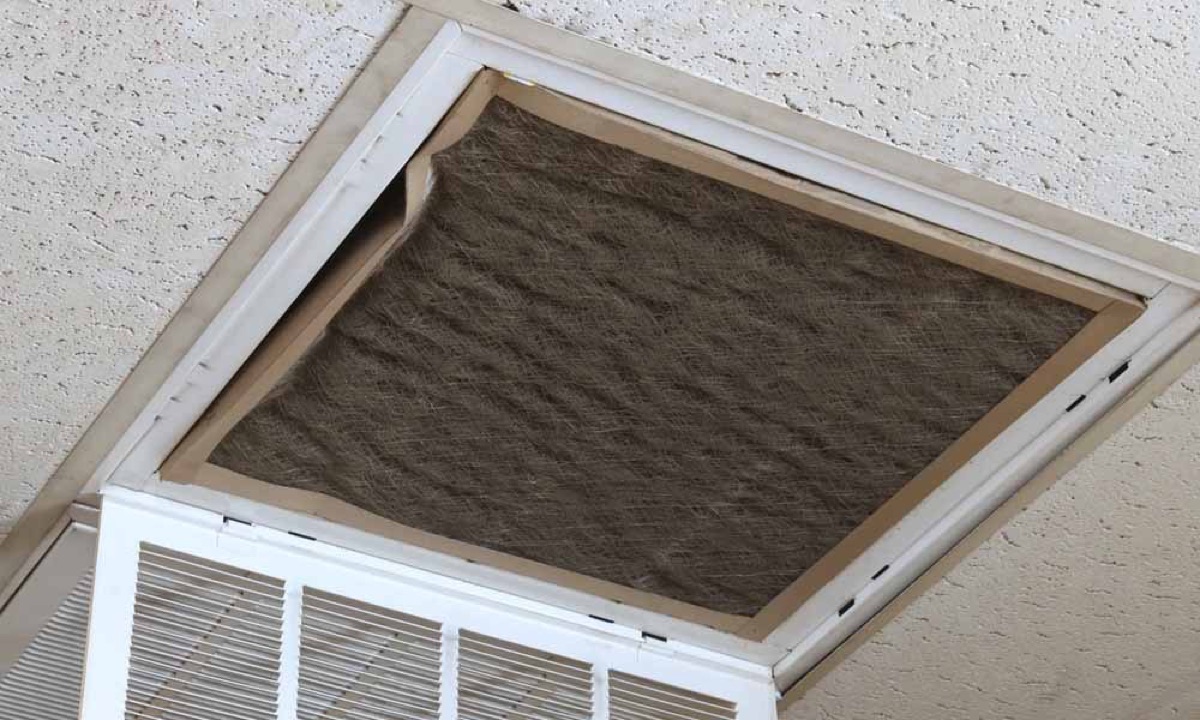
Grey by itself does not mean finished, because every filter turns grey within weeks. Blocked light means finished. The ones that worry me are filters left a full year, where the pleats have gone stiff and dark and the frame has started bowing inward under the pull of the blower. Change yours sooner if you have multiple pets, a smoker in the house, remodeling nearby, or a Santa Ana wind week that coated everything in the yard.
What Most San Diego Homes Do Not Need
Contractor articles close with a menu of upgrades, so here is the part I tell people to skip.
UV lamps. I do not install in-duct UV as a general air quality upgrade, because the evidence that a UV lamp meaningfully cleans the air in a normal house is thin, and it does nothing about the dust and smoke a filter handles.
Whole-house humidity control. The San Diego County climate rarely justifies it, and a coastal home in a bad marine layer stretch is the exception where a portable unit settles it.
A dedicated air cleaner stacked on a media cabinet. If a 4-inch cabinet fits your equipment, that cabinet plus a change schedule covers what most families need, and buying both purchases the same result twice.
What remains is short: a correctly sized filter, changed before the light stops passing through it, in a return grille that is not leaking attic dust around the frame.
Condos, Rentals, and Systems More Than 12 Years Old
Condos and closet air handlers. These slots are usually 1 inch and feed a tight return, so check the seal on the closet door and stay at MERV 8 unless static pressure has been measured.
Older systems. Blowers installed before roughly 2010 are commonly PSC motors, which quietly lose airflow as static pressure rises, while newer ECM motors ramp up to hold airflow and raise their watt draw instead. On a system older than 12 years with a PSC blower, stay at MERV 8, because equipment installed before 2023 predates the SEER2 rules and an aging blower is no place to experiment.
Rentals. In a California rental the filter is usually the tenant's to change and the owner's to make possible, so hand over the filter size in writing at move-in. A tenant who never changed a filter in two years is how a blower motor becomes an emergency call in August, and a recurring tune-up on the lease costs less than one no-cooling call.
Frequently Asked Questions
Is MERV 13 too high for my home? MERV 13 is too restrictive for a 1-inch slot on a system with an undersized return, and it is fine in a 4-inch media cabinet. The MERV number is not the problem, the filter surface area is.
Can I run my AC with no filter for a night? No. Run without a filter only for a short airflow test of roughly 15 minutes, then put one back in. Unfiltered air deposits dust straight onto the evaporator coil and blower wheel, which has to be cleaned off by hand later.
How do I know if my air filter is dirty? Hold it up to a bare bulb or a window and look through the pleats. If light passes through, the filter still has service life, and if most of the surface blocks light, replace it. Grey color alone is not the test.
I changed the filter and the airflow is still weak. What now? If a fresh filter did not restore airflow, the restriction is elsewhere: a dirty blower wheel, a frozen evaporator coil, a crushed duct, or a return too small for the equipment. Those need a static pressure reading, so a clean filter with weak airflow is a service call.
The Right Filter Is the One Your System Can Breathe Through
Buy for the filter slot you have, not for the number on the box. A MERV 8 in a 1-inch slot, changed on time, outperforms a MERV 13 that has been quietly choking your blower since spring. If you want genuine MERV 13 filtration for smoke season or for asthma, the answer is a deeper media cabinet, and I will tell you honestly whether your equipment has room.
I run every job myself, no crews and no subcontractors, which is how we hold 5.0 stars across 47 Google reviews. Everglade Heating and Air is owner-operated, NATE-certified, fully licensed and insured, and serves all of San Diego County including Alpine, Spring Valley, El Cajon, and the coast. For a free in-home estimate, call or text Karam at (619) 792-8289.
Bring me your filter size. We will start there.
Questions? The Owner Picks Up.
Flat diagnostic fee. Written estimate before any work starts. Serving all of San Diego County.
NATE Certified | EPA 608 (#1112519700410) | CA License #1154431 | Mon–Sat 7AM–7PM