thermostat won't go below 75
Why Won't Thermostat Go Below 75
Everglade Heating and Air is a fully licensed and NATE-certified HVAC company serving San Diego County homeowners, landlords, and businesses since 2020.
- 1.Key Takeaways
- 2.What Should I Check First When the House Will Not Cool?
- 3.Is Ice on the Refrigerant Line an Emergency?
- 4.Can an Air Conditioner Only Cool 20 Degrees Below the Outdoor Temperature?
- 5.Why Does the Same System Hold 72 in Pacific Beach and Stall at 75 in Alpine?
- 6.Is My Thermostat Holding the House Warm on Purpose?
- 7.Which Causes Can I Check Myself, and Which Ones Need a Technician?
- 8.The Filter Is the Cause on More of My Calls Than Anything Else
- 9.A Choked Condenser Is the Second Thing I Find
- 10.How Do I Measure My Air Conditioner's Temperature Split?
- 11.Why Leaking Attic Ducts Cause the 75 Degree Plateau in Older San Diego Homes
- 12.Is My Air Conditioner Just Old, or Was It Undersized From the Start?
- 13.Do I Need Someone Out Today, or Can This Wait?
- 14.Frequently Asked Questions
- 15.What to Do Next
Last updated: 2026-09-08
When your thermostat won't go below 75, the system is usually still cooling and losing a race against heat entering your house. I run every Everglade call across San Diego County, so the causes below come in the order I work them, cheapest first.
Set the thermostat to COOL with the target at least 3 degrees under the current room reading, then give it 15 minutes. Check the filter, the outdoor unit, and the schedule programmed into the thermostat. If the indoor coil or the copper refrigerant line has frost on it, shut cooling OFF and switch the fan to ON immediately. If none of that is wrong and the outdoor temperature is past your local design condition, holding 75°F indoors is the engineering, not a defect.
Key Takeaways
- The rule that an air conditioner only cools 20 degrees below outdoor air is wrong: that number is a design assumption, not a limit.
- ACCA Manual J sets the indoor design temperature at 75°F and pairs it with a local outdoor design temperature.
- Frost anywhere on the equipment means cooling off and fan on, because an iced coil sends liquid refrigerant back to the compressor.
- SDG&E on-peak hours run 4pm to 9pm, and a time-of-use schedule holds your house warmer then.
- ENERGY STAR puts typical duct leakage at 20% to 30% of the air a system moves.
What Should I Check First When the House Will Not Cool?
Four checks, ten minutes, no tools, in the order that resolves most calls.
- Read the thermostat itself, not the phone app. The mode must say COOL, not FAN, and the set point must sit at least 3 degrees below room temperature.
- Open the schedule and eco settings. Smart thermostats ship with energy programs on, and a schedule that raises your afternoon set point means the house is warm by design.
- Pull the filter and hold it up to a light. If no light comes through, that is your problem until something proves otherwise.
- Walk out to the outdoor unit. The fan on top should spin and the air off it should feel hot. If it sits still while the blower runs, stop and call.
Give the equipment 30 minutes after any change before judging.
Is Ice on the Refrigerant Line an Emergency?
Yes. Act on this one before you finish reading.
If you find frost or ice on the copper line, the indoor evaporator coil, or the outdoor unit, set the thermostat to COOL OFF and the FAN to ON, not AUTO. AUTO is right on a normal day, but a freeze-up is the exception, because the blower is the only thing that melts ice off that coil.
An iced coil cannot boil refrigerant into a gas, so liquid refrigerant runs back down the suction line into the compressor and washes the oil off its bearings. Compressors rarely die in one afternoon of that, but they die years early.
Leave the fan running 2 to 4 hours and replace the filter while the coil thaws. If it ices over again within a day, you have an airflow restriction or a leak, and both need professional diagnosis.
Can an Air Conditioner Only Cool 20 Degrees Below the Outdoor Temperature?
No. Six of the ten pages ranking for this question repeat it as settled fact. The 20 came out of a design table, not out of physics. ACCA Manual J, the standard contractors size equipment with, fixes the indoor design temperature at 75°F and pairs it with a local outdoor design temperature that differs by city. Subtract one from the other in a humid state like Florida and you land near 20 degrees. Somebody turned that regional spread into a law of nature.
The 75 in your question and the 75 in Manual J are the same number. A correctly sized system is engineered to hold 75°F indoors when outdoor air hits the local 1% design temperature, the level only about 1% of hours in a normal year exceed. Above that it runs outside the conditions it was chosen for. The U.S. Department of Energy makes the same point about proper HVAC sizing.
So ask which outdoor design temperature your Manual J used. If today is hotter than that while the house holds near 75, the equipment is doing its job.
Why Does the Same System Hold 72 in Pacific Beach and Stall at 75 in Alpine?
San Diego County is not one climate, and the design temperature that sized your equipment knows it. Pacific Beach sits under the marine layer, so its design day is mild and the system chosen for it is small. Thirty miles east in Alpine, El Cajon, or Spring Valley the design day is far hotter: same square footage, same brand, completely different load. Coastal customers call about humidity, while La Mesa and Poway customers call because the house parked at 76°F on a 103°F afternoon. If yours has always plateaued during the hottest week, that is design, not a fault.
Is My Thermostat Holding the House Warm on Purpose?
Frequently, yes, and this is the ten-second check most articles bury.
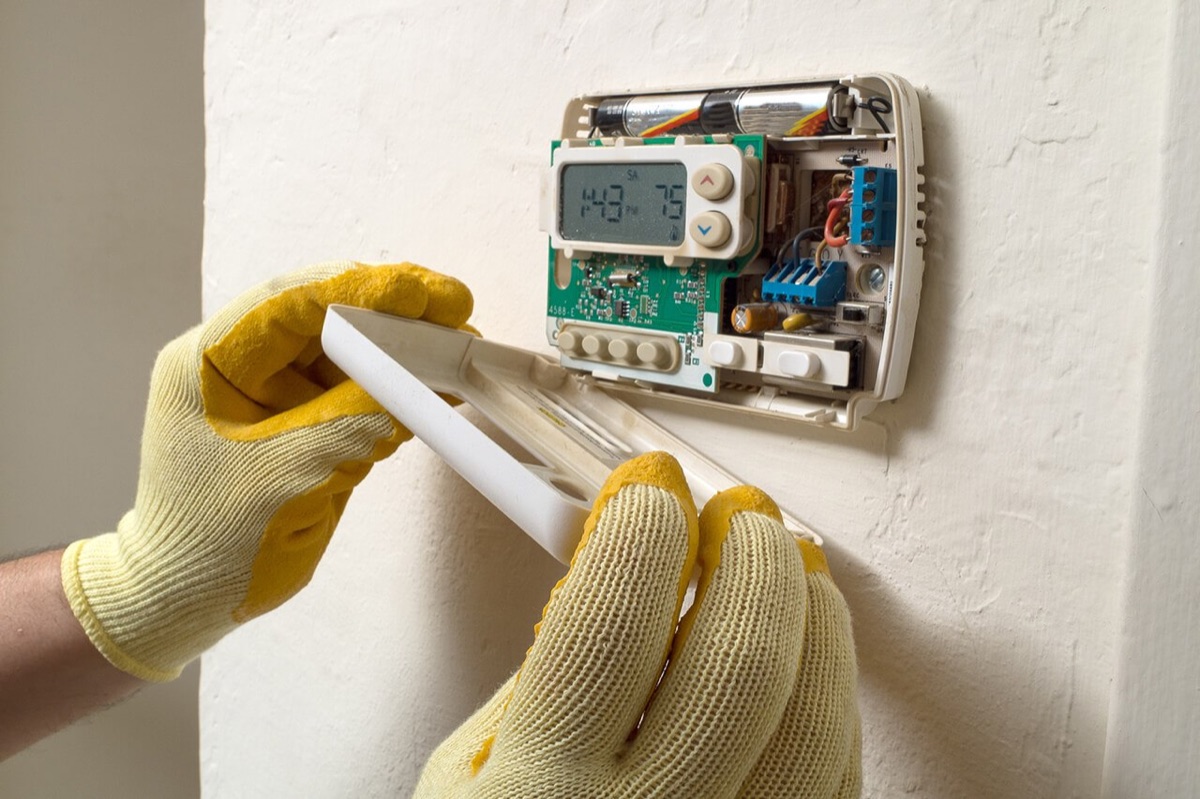
A schedule you forgot about. SDG&E on-peak pricing runs from 4pm to 9pm on weekdays, and smart thermostats and demand-response programs lean on that window, raising your set point during the hours you notice the house is stuck. Read every afternoon set point before blaming the equipment.
A thermostat in the wrong place. I find them on west-facing walls catching sun from three onward, so the sensor reads a sunlit wall, not the room. Tape a cheap thermometer beside it and compare.
Which Causes Can I Check Myself, and Which Ones Need a Technician?
This split also ranks them by expense.
Free, and yours to do: thermostat mode and schedule, the filter, closed supply registers, a blocked return grille, clearance at the outdoor unit, and the split test below.
An inexpensive part, but my job not yours: a failed run capacitor, a pitted contactor, a drifted thermostat, or a tripped condensate float switch.
Expensive, and the last conclusion to reach: a refrigerant leak, a fouled indoor coil, a failing blower motor, a worn compressor, or a system undersized the day it was installed.
Adding refrigerant is not a homeowner task. Handling most refrigerants requires EPA Section 608 certification, and a low system is a leaking one. Everglade refrigerant service starts with the leak search.
Before opening any panel or reaching into the outdoor unit, shut off the disconnect beside the condenser and the air conditioning breaker. Capacitors inside hold a dangerous charge after the power is off.
The Filter Is the Cause on More of My Calls Than Anything Else
About 30% of the summer no-cooling calls I run in San Diego County end at a filter that has sat in the same slot since last year.
Your filter lives in one of three places: a slot at the air handler, behind a large hinged return grille in a hallway ceiling or wall, or at the furnace cabinet. Look for the grille that pulls a tissue toward it.
A choked filter starves the coil of airflow: less heat removed, longer run times, higher bills, and eventually a freeze-up. In inland homes near dust or construction I change filters every 60 to 90 days. For MERV ratings and thickness, see the Everglade guide to HVAC air filters.
A Choked Condenser Is the Second Thing I Find
In San Diego I pull salt film off coils in Ocean Beach and Point Loma, jacaranda litter in La Mesa and El Cajon, and dryer lint. Salt air is the quiet one, corroding fins over years until a heat wave exposes the loss.
Clearance comes first: you want roughly 24 inches of open space on every side. I find condensers wedged against a fence with six inches of gap, recycling their own hot exhaust. The fins come second: with power off at the disconnect, rinse the coil from the inside out with a garden hose, never a pressure washer, which folds the fins flat. Restore power, run it 1 hour, then judge.
How Do I Measure My Air Conditioner's Temperature Split?
This is the one number a homeowner can measure, and it is the other 20 people confuse with the myth above. You need a digital probe thermometer, and the instant-read meat thermometer in your kitchen drawer works.
- Run the system in COOL for a continuous 15 minutes, because a reading taken sooner is not valid.
- Hold the probe an inch off the return grille for 60 seconds.
- Move to the supply register nearest the air handler and hold it there another 60 seconds.
- Subtract supply from return to get your temperature split, which technicians call delta T.
A healthy split lands between 16°F and 22°F, read as a direction, not a guarantee. In dry inland heat around Alpine or Ramona expect near 22, and on a humid coastal afternoon expect near 16, because part of the capacity goes into pulling moisture from the air.
A split under roughly 15°F means the equipment is not moving enough heat: airflow or refrigerant. A normal split of 18 or 20 while the house will not cool means the problem is load.
Why Leaking Attic Ducts Cause the 75 Degree Plateau in Older San Diego Homes
A normal split at the air handler plus a house that will not cool points at the ductwork. ENERGY STAR estimates that 20% to 30% of the air moving through a typical duct system is lost through leaks and poor connections, and in San Diego much of that runs through an attic well above 130°F on an August afternoon.
A disconnected supply run air conditions your attic instead of your bedroom. A leaking return is worse: it draws superheated attic air in, raising the return temperature so your split looks fine while the house never gets there. The repair is ductwork, not new equipment, so ask for a duct leakage test.
Is My Air Conditioner Just Old, or Was It Undersized From the Start?
Age is the vaguest diagnosis in this trade and the easiest to sell against, so hold it to numbers. If somebody says your system is worn out, ask for three readings from a hot afternoon, in writing: the temperature split, subcooling or superheat, which show whether the charge is right, and compressor amp draw against the rating plate. If all three read normal and the house still stalls at 75, the equipment is not the problem. Efficiency rules changed in 2023 when SEER2 replaced SEER, and units built from 2025 onward ship with R-454B, so a unit installed before 2023 is older, not worn out.
Sizing has its own test, and that test is history. If the house has never dropped below 75°F on a hot day since the first summer after installation, that is a sizing decision, not a fault. Undersized equipment never catches up, while oversized equipment short-cycles and never dries the air.
Do I Need Someone Out Today, or Can This Wait?
Call today if the outdoor fan is not spinning, if you smell burning, if a breaker trips repeatedly, if the system iced up twice in two days, or if anyone at home is elderly, very young, or medically vulnerable in a heat advisory. That is emergency AC repair territory.
It can wait if the system cools, just not as far as you want, and the house recovers overnight. Change the filter, take your split, and book a normal appointment.
When I arrive I read the schedule, check the filter, measure the split, and read static pressure, the air pressure inside your ducts. A high reading proves an airflow restriction before I connect a gauge.
Frequently Asked Questions
Is 76 degrees inside on a 103 degree day a broken air conditioner?
Usually not. A system sized to ACCA Manual J is engineered to hold 75°F indoors at your area's 1% outdoor design temperature, so above that it runs outside its design conditions. If the house recovers overnight and your split falls between 16°F and 22°F, it is healthy.
Should I turn my air conditioner off if the house will not cool below 75?
Only if you see frost or ice, or if the outdoor fan has stopped turning, because in both cases running it risks the compressor. Otherwise leave it on, since cycling it during a heat wave adds wear.
How long after changing the air filter should I wait to see a difference?
Give it 30 minutes of continuous runtime before judging. If the coil had frozen, thaw it first with cooling off and the fan on for 2 to 4 hours, then run the 30 minutes. Walls and furniture hold heat, so the drop is slow.
What temperature split should my air conditioner produce?
Between 16°F and 22°F, measured after 15 minutes of runtime at the return grille and the nearest supply register. Dry inland air pushes it toward 22, humid coastal air toward 16. Under 15°F points to an airflow restriction or a low charge.
How do I verify that an HVAC contractor is licensed in California?
Search the license number at cslb.ca.gov, where the C-20 classification covers warm-air heating, ventilating, and air conditioning. Everglade Heating and Air holds CSLB #1154431. Ask any contractor for that number first.
What to Do Next
Run the four free checks, then take your split. If it comes in under 15°F, if the system ices over again, or if the house has never cooled below 75°F since installation, you need gauges, not another guess. A seasonal tune-up or a maintenance plan catches filter and coil problems while they are cheap.
Everglade Heating and Air is owner-operated and NATE-certified, serving San Diego County: Alpine, Spring Valley, El Cajon, and the coast. For a free in-home diagnostic, call or text Karam at (619) 792-8289. You can also reach us here.
Check the cheap things first. They usually win.
Questions? The Owner Picks Up.
Flat diagnostic fee. Written estimate before any work starts. Serving all of San Diego County.
NATE Certified | EPA 608 (#1112519700410) | CA License #1154431 | Mon–Sat 7AM–7PM